September 2026
September is Fox Cities Marathon Time
Hopefully many of you reading this have been attending our Saturday morning summer training runs at Telulah Park and are nearly ready to go at one of the upcoming Community First Fox Cities Marathon events. We have been training all summer for this, and by now have likely completed our longest runs, to ready our bodies and minds for these events the weekend of September 18-20. It is a magical time, to host a certified marathon right here in our humble cities. Where you can participate along with other great runners and walkers, along fantastic courses, witness the terrific community support, see many friends, and be a part of something truly special. You can still register here. And there are many ways you can still volunteer to help. Here a couple that the Pacesetters actively help out with:
- Prepare Race Bibs. On Wednesday September 9 at Community First starting at 8 am. Attach timing chips to corresponding bib numbers and place in envelopes. Simply come show up to help in the morning, afternoon, or both. Located at Community First Credit Union Headquarters, 1575 Dresang Way, Neenah, off of Hwy 10 and CB interchange.
- Expo Chip Check Booth. There are shifts available Friday September 18, afternoon and evening, as well as morning shift Saturday September 19. Assure that the runner's race bib chip corresponds to the correct name. Also, help to promote our Pacesetters Club to all participants. Need to register for one of the time slots here.
Please note that after this Fox Cities Marathon weekend, starting September 26, our Saturday morning runs will transition to the Copper Rock coffee shop, starting at 8:00.
Also, our monthly FUN RUNS will continue on the second Wednesday of the month at 6 pm. Unless otherwise indicated, these feature your choice of either a 5k or 10k route, followed by fun social times with food and drinks, with alternating locations as follows:
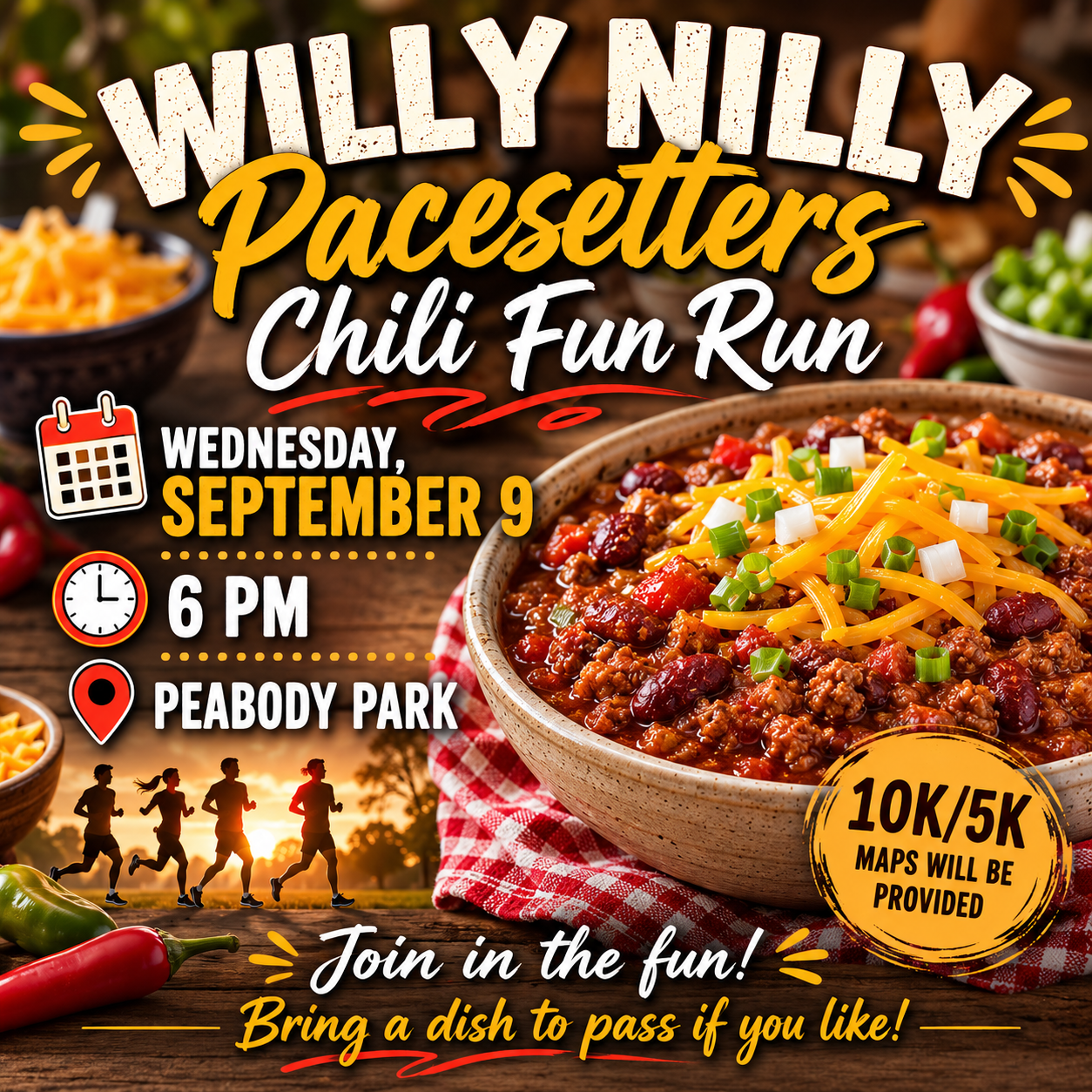
- September 9: (note revised location) Peabody Park, 601 N. Green Bay Rd, Appleton, featuring delicious chili
- October 14: Harley-Davidson, 5322 Clairemont Drive, Appleton
- November 12: Lions Tail Brewery, 116 South Commercial St, Neenah, along with Run Neenah club, 4.3 mile loop, followed by hot cocoa and cookies

Pacesetters Hosting St. Joe's Food Program 5k/10k/Kids Dash
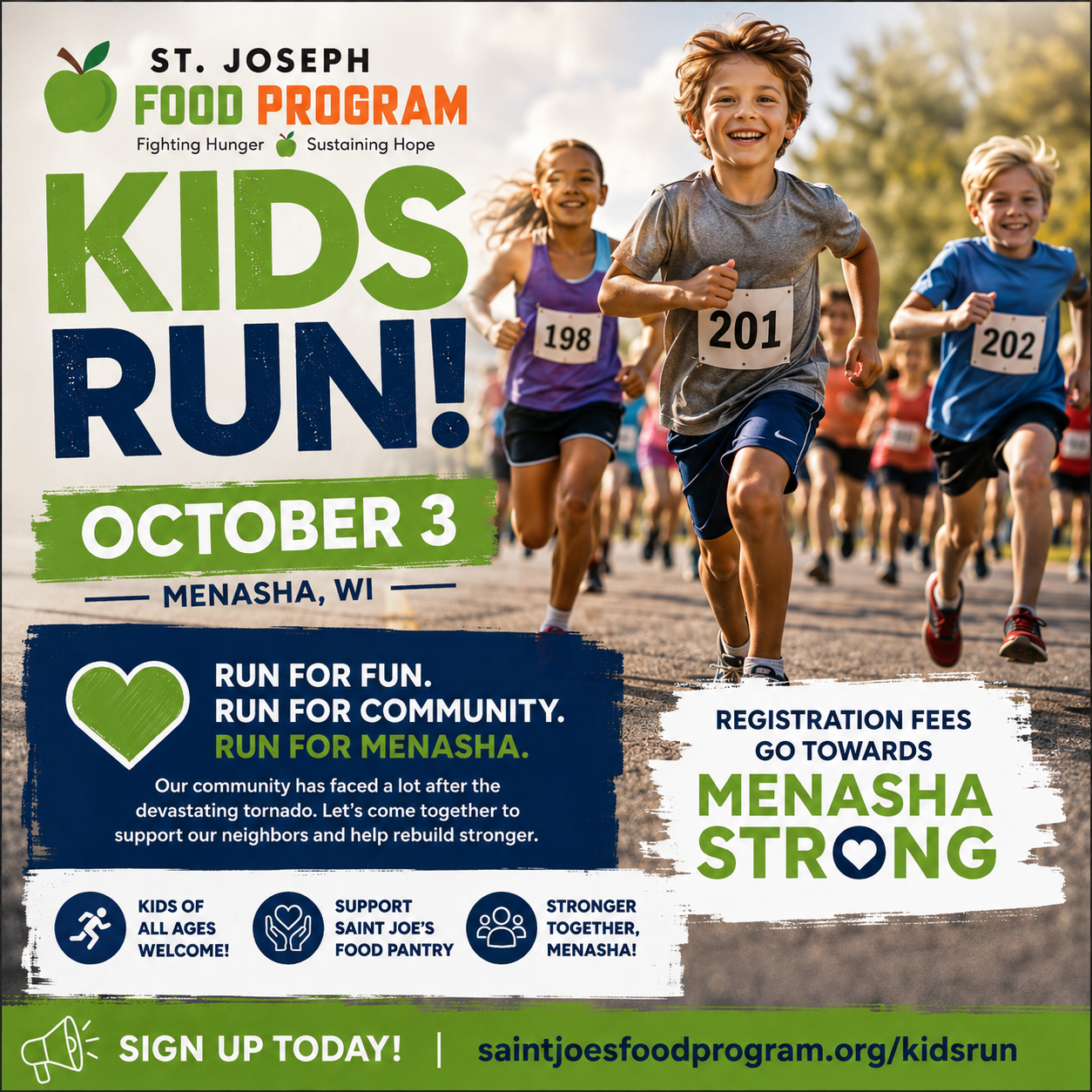
One of the very important things that the Pacesetters does every year is put on a 5k and 10k run/walk event held at St. Joseph Food Program in Menasha. Please come enjoy it with us Saturday, October 3, 2026. This is very important to our club as this worthy cause helps to provide food for people in need in our community, something that many of us take for granted. Over the last 4 years we have raised nearly $50,000. Generous past sponsors include Bergstrom, Nutritional Healing, Miron Construction, and ThedaCare. Register here.
Just added this year ... a Kid's Run .... bring the whole family!
Pacesetters Member Spotlight - Linda McDaniel
After running for over 40 years, longtime Pacesetters member Linda McDaniel has many memories to share. She's nice enough to probably even share her soup with you.
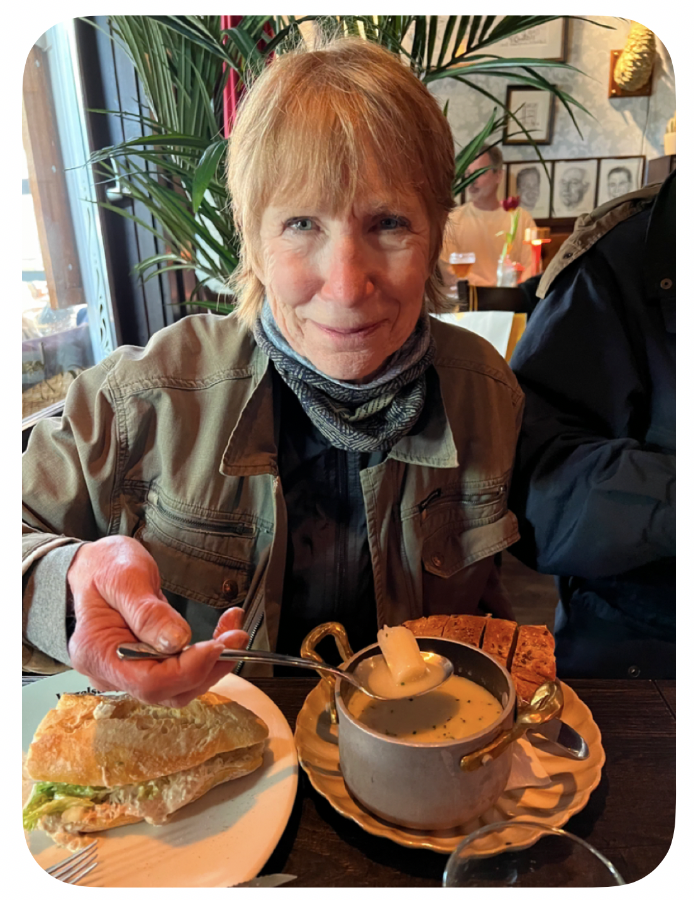
The most amazing thing about Linda is that at age 80, she continues to go out on her weekly training runs, preparing herself to complete the Fox Cities Half Marathon later this month. That is phenomenal, for someone who has already accomplished so much in her life, with nothing left to prove, to continue to challenge herself and keep moving forward. At that age many people are sedentary, and may need walkers and assistance to get around. But that's certainly not Linda!
Linda was not a runner in her earlier years. She had been a cigarette smoker for many of those years, when in January of 1986, at age 39, she decided she was going to stop. This was a challenge as she really enjoyed having a cigarette, and was nervous that she would start gaining weight when she stopped.
Then in May of that year, when Linda turned 40, she decided to try running. It was so difficult at first. She says she couldn't even run around the block, which many of us could say in those first few attempts. She was self conscious of her early running struggles and would wait until 9 pm to go out and run so she would be less noticeable in the darkness. Then over time she found that she could complete a mile. The following year she was talked into her first 5k, for Appleton Medical Center (AMC). She did not know enough to have proper attire or shoes, running it in pink leather shoes and matching shorts. She was able to complete it in 26:13, a number she knows from memory, and it felt like an amazing accomplishment for her. As if she just ran a marathon. She laughs at that now, but having the courage to go out and run around your block, and then do your first race are major achievements!
Linda continued to work hard and stretch her mileage and ability over the next 3 years until eventually signing up to run the Milwaukee Marathon in 1990. Back then, there were no local marathons around here. And there were no training runs or running clubs to help. Or running trails to use. Today we take those things for granted. Back then you had to run all your training miles in the streets. She completed that first marathon in 4:17.
A few years later Linda ran her fastest marathon on Kiawah Island, SC. Although it didn't start out so well. Several yards after her first step she somehow fell. She's not sure how that happened, whether she tripped over something or what. But she caught herself with her gloved hands, where she had packets of goo tucked away. She got up and found herself covered in sticky goo. After she regained her composure, she finished the marathon in 3:50. Perhaps a good fueling strategy, just lick goo off yourself every few miles.
In 1993, just 3 weeks after completing the third running of the Fox Cities Marathon, Linda completed the Chicago Marathon. Here she is, all smiles and clean white gloves afterwards:
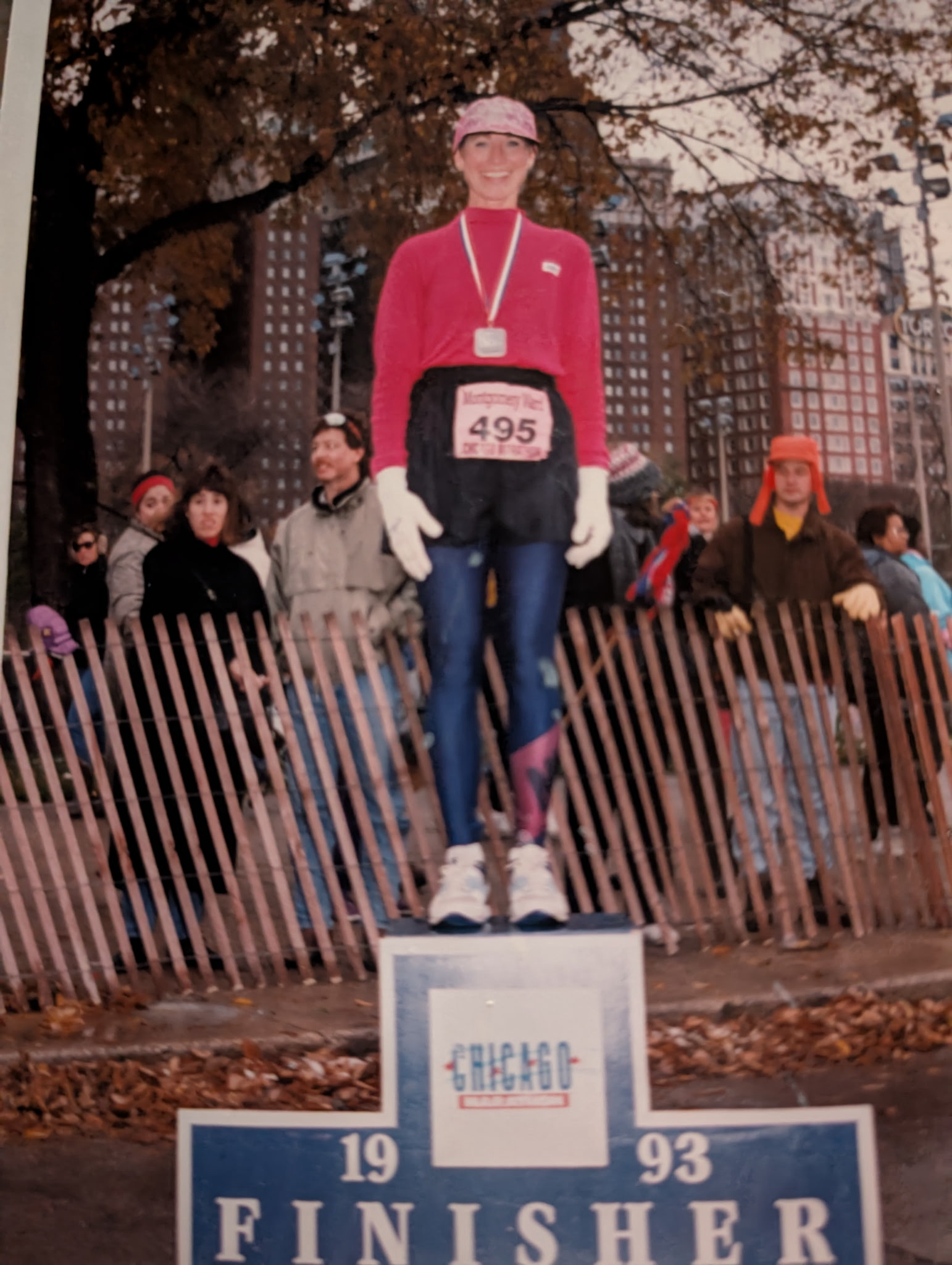
That great result qualified Linda to run Boston. In 1996, she did the 100th running of Boston. With 40,000 runners and "100" written in lights, she calls that a "thrill of a lifetime." One other thing she remembers is how everyone was talking about Heartbreak Hill prior to the race, making her a bit nervous about how difficult that would surely be. During the race, she asked one of the runners when that hill would be coming. She was surprised when she heard they had already climbed it!
Linda felt fortunate to be part of a local group of friends who travelled together for marathons. They would take turns choosing which one to do next. She fondly remembers running with these friends in London, San Antonio, Washington DC, Ireland (that one had a big hill!), and Minneapolis, and can tell you who picked each one, She has also completed marathons on Vancouver Island and among the Giant Redwoods.in northern California. But her favorite was the iconic New York Marathon. There she saw so many special things, going across the bridges and through the boroughs, singing to the YMCA song while resident spectators spelled it from their steps, and surprisingly enjoying warm coke instead of water at one of the stations. All together, Linda has completed 33 marathons!
Linda's other marathon memories include helping a male participant who she thought was sobbing but was actually singing, and being part of a larger group nearing the end hearing an announcement that this group was on pace to complete the marathon in 4:30, and then watching everyone around her press on to achieve that.
So what motivates Linda today when running a race? Linda says she no longer sets time goals for herself, but now has 2 goals .... 1) don't finish last, and 2) take first place in her age group, emphatically saying, "I'm not going to let an 80 year old woman beat me!" She somewhat embarrassedly says that she walks a lot during her runs these days. At times she feels she let's herself stop running and start walking too easily. It was so funny hearing her say that sometimes when planning a training run, she hopes it ends up raining or that something comes up so she doesn't have to go out and do it. Yet here she is, beating other 80 year old women across the finish line on race day, she certainly still has that competitive spirit and drive!
When asked whether she's had any physical setbacks over her running career, Linda replies with a simple no, and, in her usual unpretentious style, says that's because she never pushes herself too intensely. And that's her recipe for no major injuries or surgeries ever needed, for over 4 decades.
As for advice for other runners, Linda says, "you are not going to go out and complete a marathon on your first day, you need to take little steps at a time. It took me 3 months of effort to be able to work up to a 5k distance. Just never give up."
Pioneer Runner
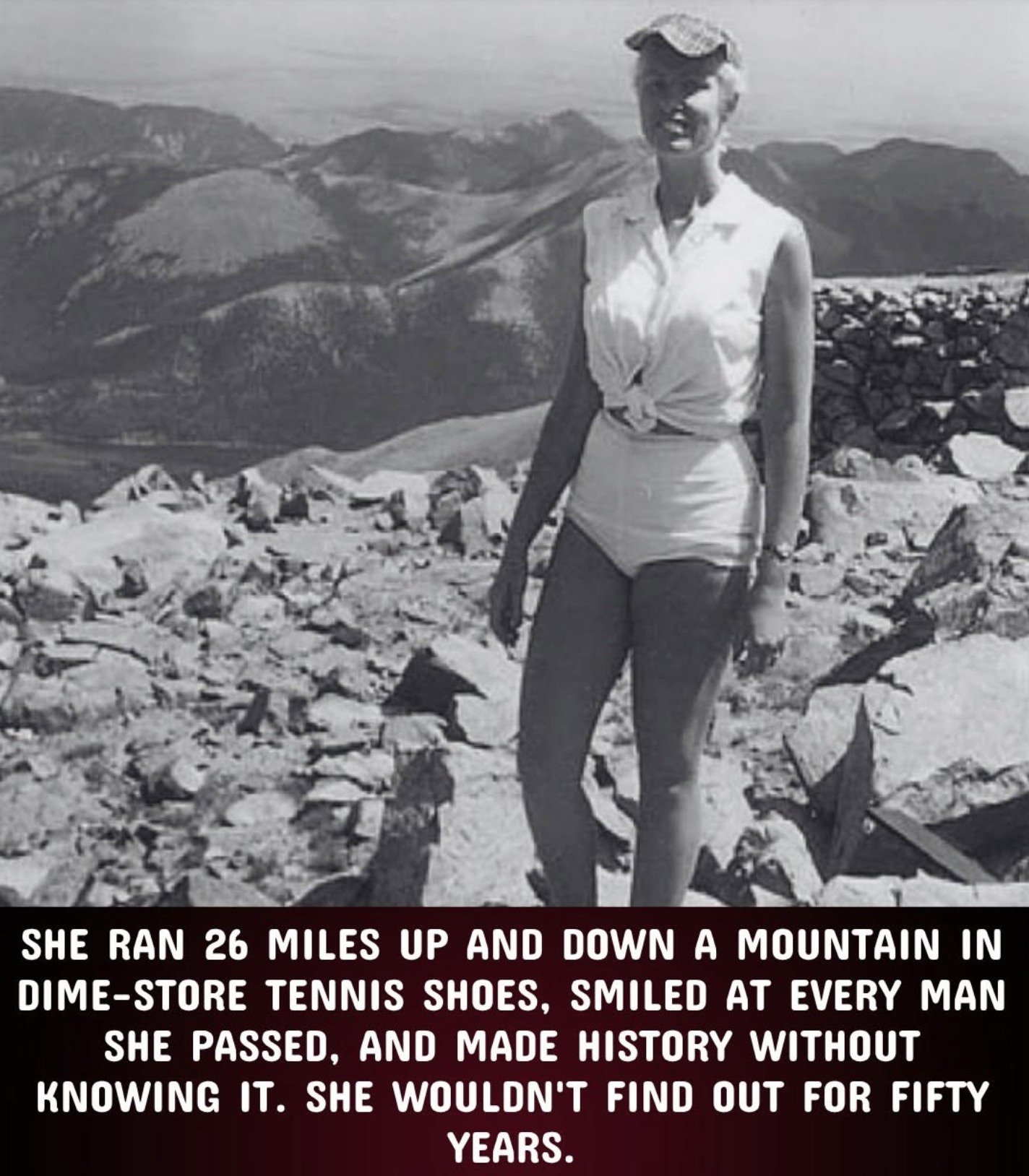
On August 7, 1959, a twenty-nine-year-old mother of three stood at the starting line of the Pikes Peak Marathon wearing white shorts, a white blouse tied at the stomach, and tennis shoes she had bought at the dime store. She looked, by several accounts, more like Marilyn Monroe than a distance runner.
Nobody at that starting line — not the race officials, not the other competitors, not Arlene Pieper herself — understood what was about to happen.
Born in California, Arlene had always been drawn to physical challenge in an era that actively discouraged women from pursuing it. In the 1950s, sweating was considered unladylike. Exercise was blamed, in certain circles, for infertility. Restrictive clothing limited what women's bodies were even allowed to do in public. The prevailing message was clear: women were not supposed to push themselves, and they were certainly not supposed to run marathons.
Arlene and her husband Wallen had moved to Colorado Springs in 1957 and opened a women's fitness studio called Arlene's Health Studio. They needed something to draw attention to the business. Something to get women through the door. So Arlene decided to run the Pikes Peak Marathon. The race was brutal by any measure — 13.3 miles straight up to a 14,115-foot summit, then 13.3 miles back down. More than 8,000 feet of vertical gain. Thin air and rocky trails and the kind of course that tests people who have spent their entire lives preparing for exactly this.
In 1958, Arlene ran the ascent and reached the summit and stopped. She was disqualified for not completing the full race. Her daughter Kathie would later recall her response with simple clarity. That got her upset, Kathie said. And she said she was going back next year.
So Arlene trained for a year. She built speed on a local track with her three children parked in the center with a picnic lunch, watching their mother run circles around them. On Sundays, she went up the mountain and back, week after week, learning the terrain and the altitude and the particular demands of a course that showed no mercy to anyone who arrived unprepared.
Arlene's philosophy about all of it was practical and direct. You can be a wonderful mother and a wonderful wife, she said, but if there is anything you want to do for yourself, just get out and go for it.
On race day, there were twelve runners at the starting line. Arlene. Her nine-year-old daughter Kathie, who would run the ascent. Another woman running only the uphill portion. And nine men, several of whom had traveled from out of state. The men who came from elsewhere had not trained on the mountain. Arlene had trained on almost nothing else. She didn't run much on the way up — it was more of a sustained, focused hike. But her altitude conditioning was quietly doing its work. She began passing the men who had underestimated what the thin air at elevation would cost them. Each time she went by one, she would smile and say — with the cheerful precision of someone who knew exactly what she was doing — Isn't it a beautiful day for a race? Then she would pick up the pace and run past. When she reached the summit, she waved over her shoulder at the crowd without breaking stride.
That was where Kathie's race ended. The nine-year-old had reached the top in five hours, forty-four minutes, and fifty-two seconds, becoming the youngest competitor ever to finish the ascent. The local newspaper devoted considerable attention to the little girl's achievement.
Arlene kept going. Down the mountain. Back to the starting line. She finished in nine hours and sixteen minutes.
At the finish line, Arlene said later, she felt pretty good. A little tired, but not completely exhausted. She lost all her toenails a few days after. The newspaper noted that she had completed the marathon. No one said what that meant. No one stood at the finish line and announced that a woman had just done something that had never officially been done before in the United States. Life continued. Arlene went back to work at the studio. She never ran another marathon.
Seven years later, Roberta Gibb hid in the bushes near the Boston Marathon course and ran it unofficially, becoming the first woman to complete Boston without a number. Eight years after that, in 1967, Kathrine Switzer registered using her initials to obscure her gender, received an official bib, and became the first woman to run Boston as a registered competitor. A race official attempted to physically remove her from the course mid-race. The photographs traveled around the world. Switzer became known as the first woman to officially run a sanctioned marathon.
Except she wasn't. Arlene Pieper had done it eight years before Switzer, on a mountain in Colorado, in dime-store shoes, while smiling at the men she passed.
But by then, Arlene had moved away from Colorado Springs. She had remarried. She had moved again. She had changed her name from Pieper to Stine. She had disappeared, not dramatically but in the ordinary way that lives disappear — through relocation and remarriage and the accumulation of years spent doing something other than being famous.
Decades passed. When people at Pikes Peak began to realize what Arlene had done, they tried to find her. Nobody knew where she had gone. Nobody knew if she was still alive.
In 2002, the race's new director, hired a private detective. The detective came back empty-handed. In 2009, planning the fiftieth anniversary of the race, an advertisement in a local newspaper offered a $300 reward for information about Arlene's whereabouts. A genealogist went through library records, public documents and followed every thread they could find, eventually finding her — an unassuming woman living quietly near Fresno, California.
When Arlene was called and told she had been the first woman to officially complete a marathon in the United States, she was stunned. "It just blew me away," Arlene remembers. "I said, 'I'm the first?' " She had carried a place in history for fifty years without knowing it was hers.
In 2009, Arlene returned to Manitou Springs for the fiftieth anniversary celebration. She and Kathie were received like royalty. Arlene was made the official race starter, standing on a ladder to send hundreds of runners off with a simple command: Runners, ready. Go. She became, in the final years of her life, a folk hero to the running community. People lined up to shake her hand and ask for her autograph and request a photograph and — in the particular way that athletes seek connection with greatness they can feel but not fully explain — simply to touch her hand for luck.
In 2014, Runner's World named Arlene a Hero of Running. In 2016, she was inducted into the Colorado Springs Sports Hall of Fame. In 2019, on the sixtieth anniversary, thirty women dressed exactly as Arlene had dressed in 1959 — white shorts, white blouses, hats — and ran up Pikes Peak in her honor. Arlene, then eighty-nine, attended the celebration. One of those women said what many of them were thinking. Arlene had a cavalier attitude that she could do it, she said. Her marathon mattered in 1959, and it still matters today. She gave women permission to run.
Arlene Pieper Stine died on February 11, 2021, at the age of ninety. She had spent most of her life not knowing she had been first. She spent her final twelve years celebrated as a pioneer. And by every account, she received that recognition with the same uncomplicated directness she had brought to everything else — not false modesty, not overwhelming surprise, just the quiet satisfaction of someone who had always believed that women should do things for themselves and had simply gone ahead and proved it.
Arlene did not run that mountain in 1959 to make history. She did not set out to break barriers or deliver a statement or give future generations a story to tell. She did it because she wanted to. Because she had trained for it and showed up and was not the kind of person who stopped before the finish line. She climbed to 14,115 feet in shoes that cost almost nothing, came back down smiling, and then went back to work.
Fifty years later, the world caught up to what Arlene had done. She was just as surprised as everyone else.
For those raised to believe that doing something for yourself — not for recognition, not for history, just because you wanted to and you could — is reason enough: when was the last time you gave yourself that kind of permission?
Protein Energy Bites Treats - September

Here is our monthly Protein Bites recipe for September, courtesy of our Pacesetters President Cyndi. It's the season of the apple ... CINNAMON APPLE PROTEIN BITES.
- 1-1/4 cups old-fashioned rolled oats (can use gluten free oats)
- 1 Tablespoon ground flaxseed
- 1 Tablespoon chia seeds
- 1 teaspoon ground cinnamon
- 1/4 teaspoon ground allspice
- 1/8 teaspoon sea salt
- 1/2 cup almond butter (or peanut butter)
- 1/4 cup honey
- 1/2 teaspoon pure vanilla extract
- 3/4 cup chopped dried apples (or freeze dried apples)
Mix all together, refrigerate and enjoy!